On Sunday, August 25, friends, fans, and family from near and far gathered at the Piano Craft Gallery in Boston’s South End for Ryan Horton’s talk and tour of “Ego & Insecurities.” The first solo exhibition from the artist brings works that grapple with the duality of these parts of the self and the constant balancing act that is their coexistence. The work is introspective yet ultimately calls upon viewers to think critically about how we steady our self-perceptions in the face of our experiences.
Horton came to Boston to earn his master’s degree in architecture from Northeastern University. In conversation with fellow local artist Jamaal Eversley, Horton describes single-line drawing and digital collage as his “one-two punch”—both of which are amply represented throughout the exhibition. Round and rectangular canvases ranging from 12” x 12” to 48” x 60” hang in the gallery alongside three three-dimensional installations. Vibrant red orbs recur throughout the show illustrating the intrepid ego, offsetting abstract line drawings symbolic of diffidence and the artist’s tendency toward overthinking. At times, however, these drawings offer assurance where a continuous line connects myriad faces emblematic of community.
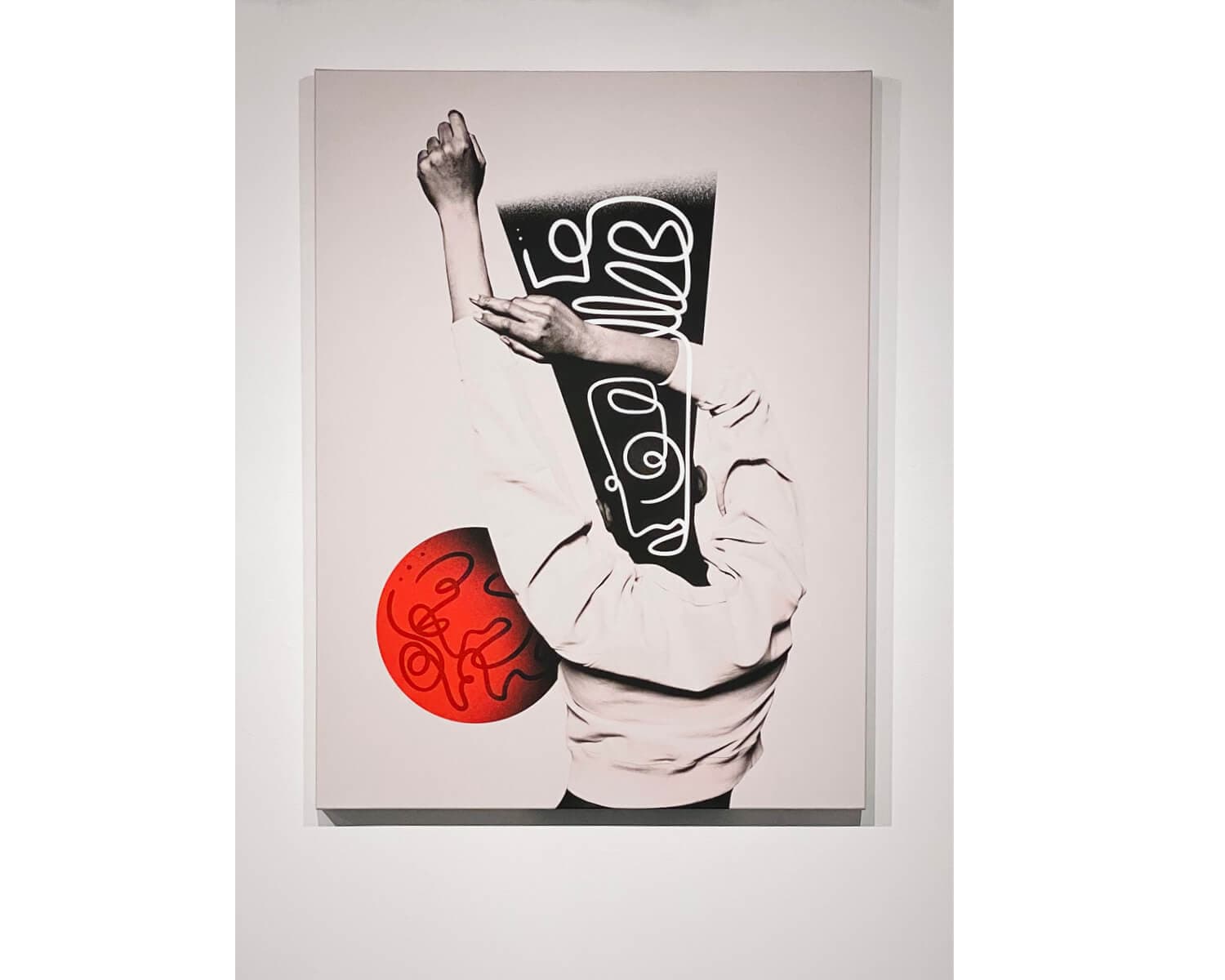
Ryan Horton, ” Reach,” 2024. Photo by Ryan Horton. Courtesy of the artist.
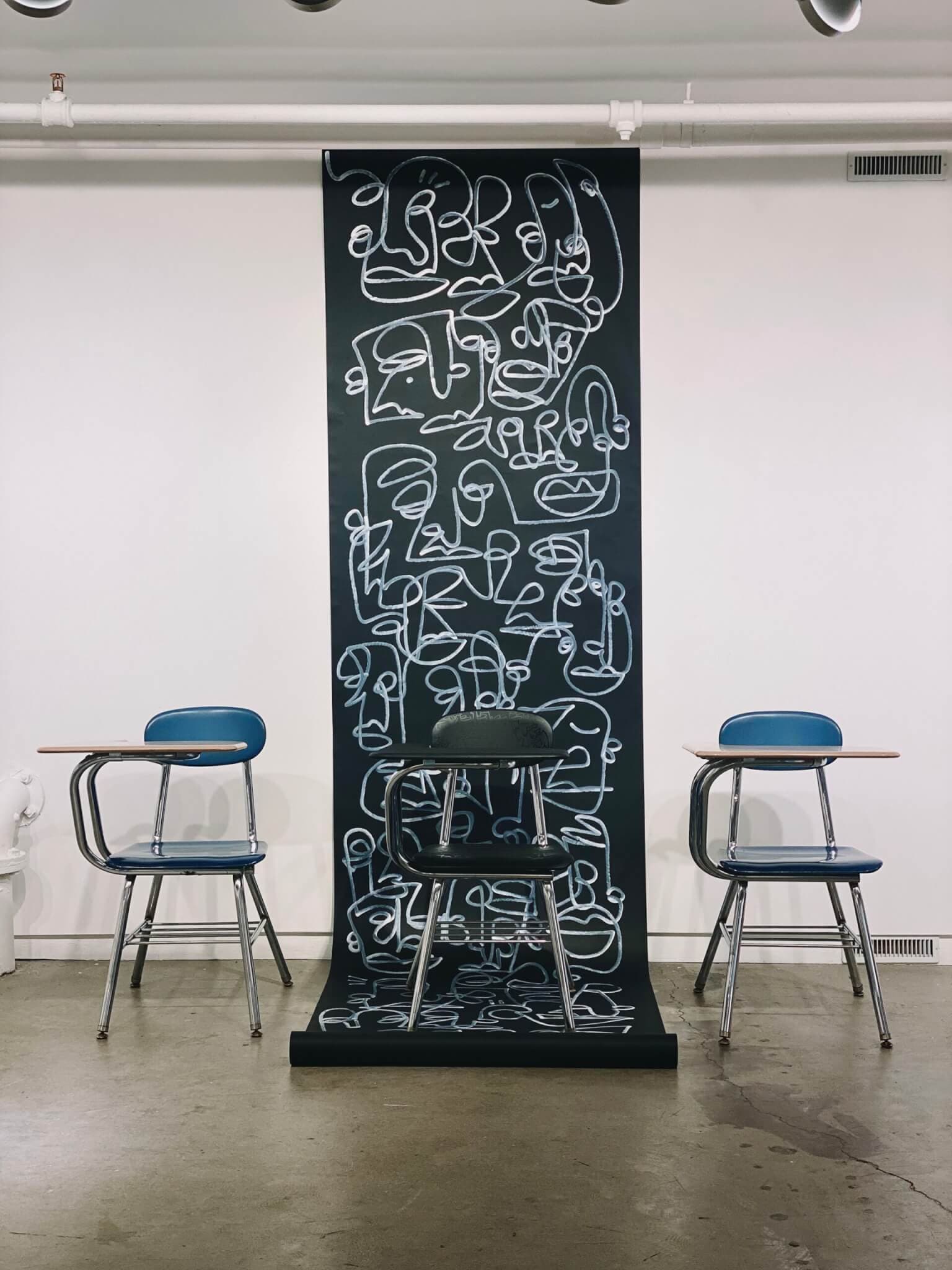
Ryan Horton, “Act Like You Got Some Sense,” 2024. Ryan Horton, “Ego & Insecurities,” installation view, Piano Craft Gallery, Boston 2024. Photo by Ryan Horton. Courtesy of the artist.
The Georgia-born artist relishes in a fierce appreciation for grillz, the precious metal and jewel-encrusted adornments for one’s teeth that originated in Black American Southern culture. Many of Horton’s digital collages feature outstretched grillz and big ring-studded hands. The show takes up what is often lost about bold ego-driven forms of self-fashioning: the flipside that is vulnerability and the psychological labor of balancing the two. While the striking shapes and eye-catching colors present in the work signal an ostensible self-assuredness, it is actually a deeply self-conscious show. Horton lays bare the roots of his insecurities by turning inward to reflect on his family life after the passing of his father, work and school environments where he felt compelled to code-switch to get by, and broader social expectations of and projections upon Black men in America. He successfully argues that the seemingly antipodal ego and insecurity necessarily work together, each one protecting him from the other.
Ancestral Bonds (2022), the largest two-dimensional work, pays homage to those that came before us. Two faces emerge on either side of a central black pillar creating a stark contrast against the white canvas.One face looks forward, and the other backward. A bright white contour depicting multiple faces moves vertically along the black center and within the figure—community at its core. Horton explained that the piece is a reminder of the resilience and strength passed down from our ancestors as we proceed along our journey through life.
He names Keith Haring, Jean-Michel Basquiat, and Amy Sherald as artists who have influenced his creativity. Locating himself in the evergreen debate of what constitutes “Black art,” Horton is resolute that he always intends for his art to be legible as Black art. Using exclusively Black figures and references to cultural elements that are distinctly Black, he achieves just that.

Ryan Horton, Saving Face, 2024. Krink marker on plastic over a plush chair. Ryan Horton, “Ego & Insecurities,” installation view, Piano Craft Gallery, Boston, 2024. Photo by Ryan Horton. Courtesy of the artist.
The three installations on view all use different kinds of chairs to interrogate sites of simultaneous comfort and discomfort. Saving Face (2024) features Horton’s signature line drawing using krink marker in an unusual place: the plastic covering of a plush chair. During his talk, Horton recalled the hot sticky feeling of visiting family and sitting on his elder’s sofa draped in plastic in the New York City summer heat. Transforming that discomfort, the installation asks us what old ideas we might be holding onto and whether their preservation is truly to our benefit. Doing the work to answer that question, Horton offers a thoughtful examination of his own ego and insecurities.
“Ego & Insecurities” is on view at the Piano Craft Gallery, 793 Tremont Street, Boston, MA, August 23–September 8, 2024.